Jam First, Judgement Second: How to Read a Bournemouth Hotel Through Its Afternoon Tea
There is a particular sound a well-run hotel makes at four o'clock in November. It isn't the clink of china, although there's some of that. It's the low murmur of a room where nobody is rushing anybody — where a couple in the window seat have been on the same pot for forty minutes and the staff have decided that's absolutely fine.
Afternoon tea doesn't get much attention in the brochures. It sits somewhere below the spa and above the car park on the list of things a hotel wants to talk about. Which is precisely why it's worth paying attention to. Nobody buys a chandelier to serve a scone, so the tea service is one of the few things on offer that a hotel has to get right with labour, timing and attention rather than with a refurbishment budget.
The pot is the first honest thing you meet
Start with what actually arrives on the table.
Loose leaf isn't automatically better than a bag — some very good hotels use excellent quality bags and are grown-up enough to say so. But there's a difference between a choice and a shrug. A pot of loose leaf, brewed in the kitchen and sent out with a strainer and a small jug of hot water, tells you somebody has thought about the sequence. A bag dumped in a pot of tepid water and sent out with a chipped lid tells you the opposite, and it tells you quickly.
The best single test is the second pot of hot water. Ask for one. Watch whether it comes without a sigh, whether it's actually hot, and whether anyone thinks to ask if you'd like more milk. In a hotel that's running properly, that request is nothing. In one that isn't, it's an inconvenience, and you'll see it in the face of whoever fetches it.
Sandwiches are where the kitchen's budget shows
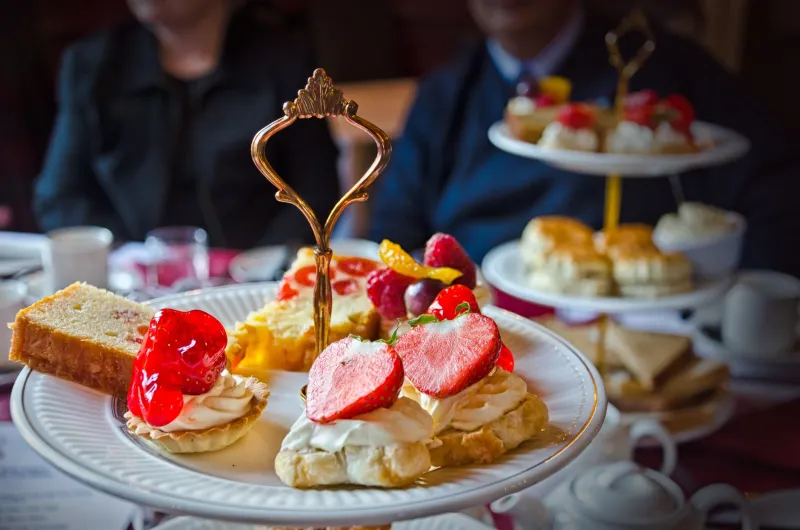
Finger sandwiches are cheap to make and easy to get wrong in a way that's visible from across the room.
Look for the small things. Cucumber that's been salted and drained rather than sliced wet onto butter. Smoked salmon that's been seasoned, with a bit of lemon in it. Ham that isn't the same ham that turned up on the breakfast buffet. Bread that hasn't spent the afternoon drying out under a cloth.
The really telling one, though, is the vegetarian option. If the meat-free sandwich is cheese and chutney and nothing else — the same cheese and chutney they've been serving since the room was last decorated — then nobody in that kitchen has been asked to think about the tea menu in a while. If it's something with a bit of invention in it, that's a kitchen with a live interest in what it sends out.
The scone warmth problem
A cold scone is a scheduling failure, not a culinary one. Scones go stale within a couple of hours, so a hotel that bakes in the morning and serves all afternoon has to warm them before they go out. If your scones are stone cold and arrive at the same moment as the sandwiches, someone has plated the whole stand in one go at half three and left it standing. Warm scones turning up five or ten minutes after the sandwiches is, oddly, a very good sign: it means the kitchen is cooking to order rather than to a rota.
As for the jam and cream question, take the Cornish-Devon spat as seriously as you like, but judge the hotel on generosity rather than doctrine. A good tea gives you enough of both, in dishes rather than sachets, and doesn't lecture you about the correct order.
The room does half the work
In Bournemouth, the tea itself is only part of the experience, because a lot of these hotels have a conservatory, a sun lounge or a front room with a sea view, and in November those rooms are doing serious emotional labour.
What you want is glass, low winter sun, and lamps that come on at half past four rather than at six. The classic failure is a beautiful sea-view lounge that's too cold to sit in, or one lit so brightly at dusk that the view outside disappears entirely and you're left staring at your own reflection in a bay window. The good ones get the lighting right because somebody has actually sat in there at teatime in winter and noticed.
If you're booking a winter 2026 break, look hard at the photographs of the room the tea is served in, not the tea itself. A wicker chair in a conservatory with the radiator on is worth more than a silver stand in a function room.
What the booking page quietly tells you
Two small questions will tell you a lot before you ever arrive.
First, what times are offered? A single sitting at four o'clock is standard. Two sittings, say two thirty and four thirty, suggests a hotel that knows its tea service is busy and has organised itself accordingly. Second, will they hold a particular table? If a hotel will take a note about the window seat when you book, it's a hotel that reads the notes.
And if you ring to ask something simple — which teas are on the list, whether they can do a dairy-free version — the answer matters less than the manner. Whoever picks up the phone is a decent proxy for whoever will bring the pot.
The verdict, before you unpack
None of this is about tea, really. It's about whether a hotel treats a small, unglamorous, low-margin service as though it matters. A place that refreshes the pot, warms the scones and thinks about the vegetarian sandwich is a place where the heating in your room probably works and the breakfast is probably looked after.
So book the tea. Not as an indulgence, but as a reconnaissance mission — and preferably on the first afternoon of a winter break, while there's still time to move your table nearer the window.